- 5 月 19, 2026
- News
- 0 Comments
Planetary gearboxes are everywhere in modern industry — from robotics and CNC machinery to automated production lines and packaging equipment. Yet for many people, understanding how a planetary gearbox works can seem surprisingly complicated.
The good news is that the basic concept is actually simple.
Once you understand the relationship between the “sun,” “planets,” and “ring,” the entire system becomes much easier to visualize. In this article, we’ll break down planetary gearbox operation in the simplest way possible while also exploring why this technology is so widely used in precision automation.
Why Is It Called a Planetary Gearbox?
The name comes from the way the gears move.
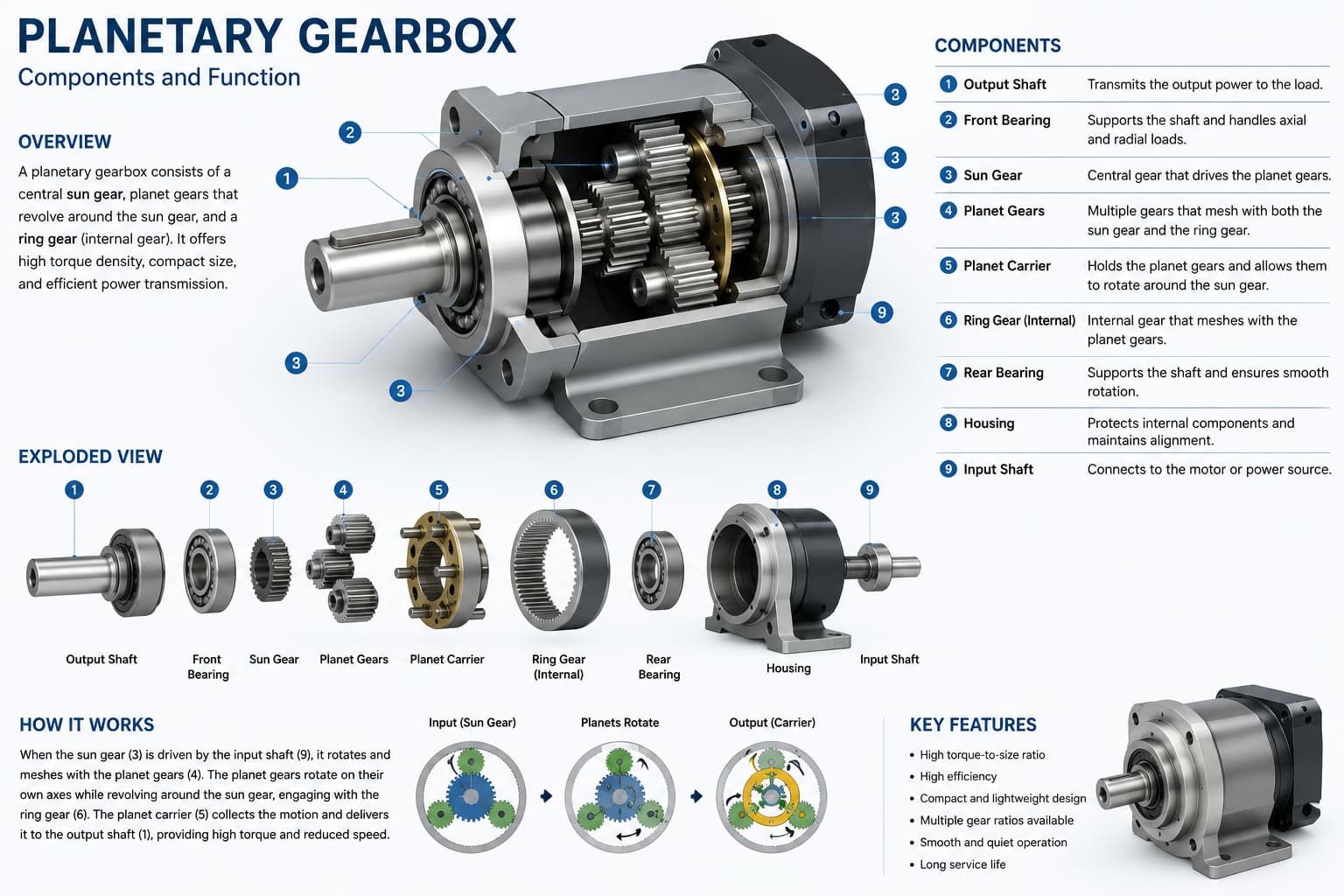
A planetary gearbox contains:
- One sun gearat the center
- Multiple planet gearssurrounding the sun gear
- One outer ring gear
- A carrierthat holds the planet gears together
The motion resembles planets orbiting around the sun — which is why it’s called a “planetary” gearbox.
The Simple Working Principle
The easiest way to understand a planetary gearbox is to think of it as a system that spreads power across multiple gears instead of relying on only one.
Here’s how it works:
- The motor drives the sun gear
- The sun gear rotates the planet gears
- The planet gears rotate inside the ring gear
- The carriertransfers the output torque
Because multiple planet gears share the load simultaneously, the gearbox can handle high torque while remaining compact and efficient.
Why Planetary Gearboxes Are So Efficient
One major advantage of planetary gearboxes is balanced load distribution.
Unlike traditional gear systems where force may concentrate on a single gear set, planetary designs distribute force evenly among several planet gears. This results in:
- Higher torque density
- Better stability
- Lower vibration
- Reduced wear
- Longer service life
This is one reason planetary gearboxes are widely used in industrial automation and servo motor systems.
A Real-World Example
Imagine riding a bicycle uphill.
If you use the wrong gear ratio, pedaling becomes difficult. But with the proper gear setup, the bicycle can generate more torque with less effort.
A planetary gearbox works similarly. It reduces motor speed while increasing torque output, allowing machinery to move heavy loads more efficiently and precisely.
Main Advantages of Planetary Gearboxes
Compact Design
Planetary gearboxes deliver high performance in a relatively small package, making them ideal for equipment with limited installation space.
High Torque Output
Because multiple gears share the load, planetary systems can handle demanding industrial applications.
Excellent Precision
Modern planetary gearboxes offer low backlash, making them suitable for servo-driven systems and precision motion control.
High Efficiency
Many planetary gearboxes achieve efficiency levels above 90%, helping reduce energy loss.
Durability
Their robust structure allows for long operating life even in continuous industrial environments.
Common Applications of Planetary Gearboxes
Today, planetary gearboxes are used in a wide range of industries, including:
- Robotics
- CNC machinery
- Packaging systems
- Semiconductor equipment
- Automated production lines
- Medical equipment
- AGV systems
- Printing machinery
As automation technology continues advancing, demand for compact and high-precision gearbox solutions continues to grow.
Choosing the Right Planetary Gearbox
Not all planetary gearboxes are designed for the same application. Important factors include:
- Torque requirements
- Speed ratio
- Backlash level
- Mounting configuration
- Precision requirements
- Operating environment
This is why manufacturers increasingly rely on specialized gearbox providers like GearKo for customized motion control solutions.
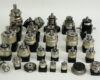
GearKo offers multiple planetary gearbox reducer series designed for various automation and industrial applications, including:
- TB Series
- TBR Series
- TE Series
- TER Series
- TCB Series
- TCBR Series
- TF Series
- TFR Series
- TCE Series
- TD Series
- TDR Series
- THG Series
These product lines support applications requiring compact design, stable transmission, high torque, and precision positioning.
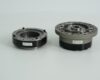
In addition to planetary gearbox systems, GearKo also provides harmonic-related gearbox series such as:
- TMCF Series
- TMHF Series
These are commonly used in robotics and high-precision automation environments.
Why Planetary Gearboxes Remain Popular
The reason planetary gearboxes continue dominating industrial automation is simple:
They offer an outstanding balance of:
- Power
- Precision
- Efficiency
- Durability
- Compactness
Very few gearbox technologies can deliver all these benefits simultaneously.
For manufacturers looking to improve machine performance while maintaining compact equipment design, planetary gearboxes remain one of the most reliable solutions available.
Conclusion
Understanding how a planetary gearbox works doesn’t have to be difficult.
At its core, the system simply uses multiple rotating gears to distribute power more efficiently. This clever design allows planetary gearboxes to deliver high torque, smooth operation, and excellent precision in a compact structure.
As industries continue adopting smarter automation technologies, advanced gearbox solutions from companies like GearKo will continue playing a critical role in improving machine performance and motion control efficiency across modern manufacturing environments.