- 4 月 25, 2026
- News
- 0 Comments
When selecting a gear type for industrial applications, the choice often comes down to two of the most common options: spur gears and helical gears. Each has its own strengths, limitations, and ideal use cases. Understanding these differences is key to choosing the right gearbox for performance, durability, and efficiency.
Spur Gears: Simple, Cost-Effective, and Widely Used
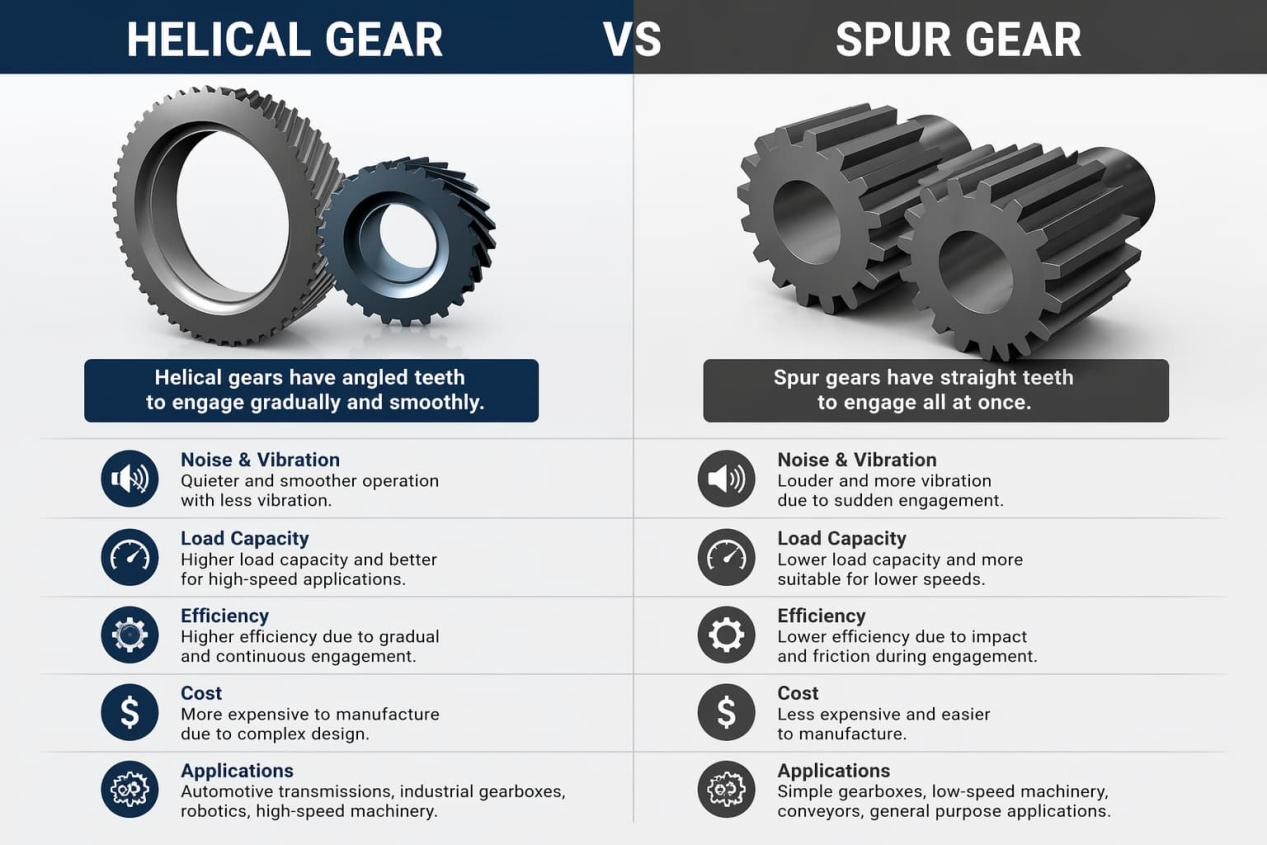
Spur gears are the most traditional and widely used gear type. Their design is straightforward, with teeth that are parallel to the shaft of rotation. This simplicity makes them easy to manufacture and maintain.
Key characteristics of spur gears:
- Teeth are parallel to the shaft
- Produce radial loads only(no thrust loads)
- Best suited for moderate speedsto control noise
- Low costand low maintenance
- Commonly used in a wide range of general-purpose applications
Because of their design, spur gears tend to generate more noise and vibration at higher speeds. For applications where cost is the primary concern and operating conditions are not extreme, they remain a practical choice.
Helical Gears: High Performance and Smooth Operation
Helical gears take a more advanced approach. Their teeth are cut at a helical angle, which allows for smoother and more gradual engagement between gears.
Key characteristics of helical gears:
- Teeth are angled (helical) rather than straight
- Capable of handling higher loads
- Produce less vibration and noise
- Operate efficiently at higher speeds
- Ideal for high-performance gear reducersand servo gear systems
This angled design results in better load distribution and quieter operation, making helical gears the preferred option in demanding industrial environments where performance and reliability are critical.
Key Differences at a Glance
| Feature | Spur Gear | Helical Gear |
| Tooth Orientation | Parallel to shaft | Angled (helical) |
| Load Handling | Moderate | High |
| Noise & Vibration | Higher at speed | Lower, smoother operation |
| Speed Capability | Moderate | High |
| Cost | Lower | Higher (but higher performance) |
| Maintenance | Low | Moderate |
Why Gear Choice Matters for Your Gearbox
While spur gears offer affordability and simplicity, modern industrial systems increasingly demand higher efficiency, quieter operation, and greater load capacity. This is where helical gears stand out.
Gearboxes designed with helical gears provide:
- Improved durability under heavy loads
- Reduced operational noise (important for precision environments)
- Better performance at high speeds
Why GearKo Focuses on Helical Gear Technology
At GearKo, the focus is on delivering high-performance gearboxes built for today’s demanding applications. That’s why GearKo gearboxes are designed exclusively with helical gears.
By using only helical gear technology, GearKo ensures:
- Smoother and quieter operation
- Higher load capacity for industrial use
- Reliable performance in servo and high-speed systems
Rather than compromising between cost and performance, GearKo prioritizes efficiency, durability, and precision—making it a strong choice for applications where performance truly matters.
Final Thoughts
Spur gears still have their place in simple, cost-sensitive applications. However, for industries that require higher speed, heavier loads, and reduced noise, helical gears are the clear upgrade.
If your application demands more than basic functionality, a helical gear-based solution—like those offered by GearKo—can deliver the performance and reliability needed to stay ahead.