- 5 月 13, 2026
- News
- 0 Comments
Planetary gearboxes are essential components in modern mechanical systems, offering compact size, high torque capacity, and excellent efficiency. While single-stage gearboxes are straightforward, multi-stage planetary gearboxes—including 2-stage, 3-stage, and 4-stage designs—offer extended capabilities for high-torque and high-reduction applications. Understanding these differences is crucial for engineers and system designers.
Single-Stage Planetary Gearboxes
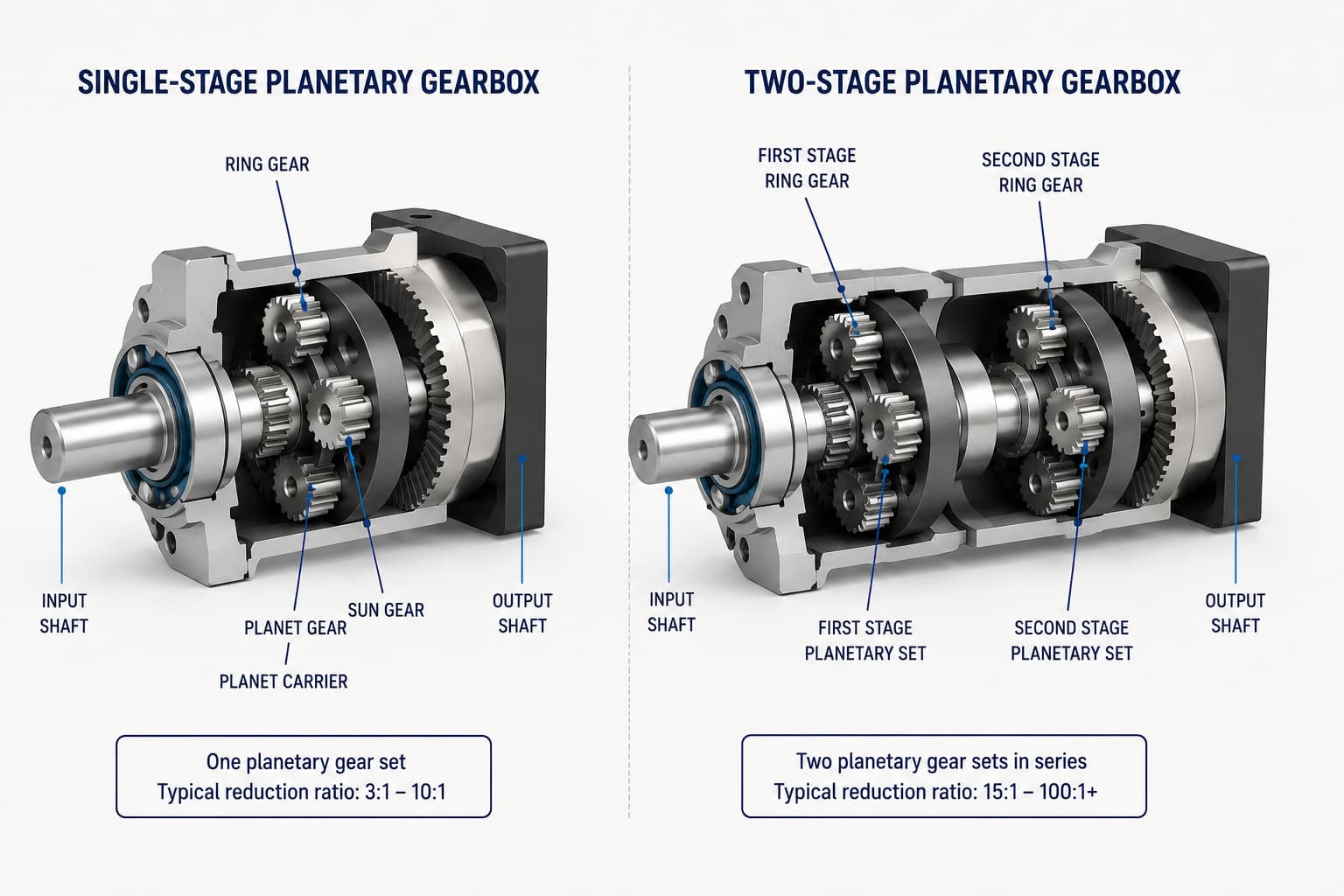
A single-stage planetary gearbox consists of one sun gear, one set of planet gears, and a ring gear.
Key Features:
- Reduction Ratio: Typically up to 10:1.
- Torque Output: Moderate, suitable for light to medium loads.
- Size & Complexity: Compact, simple, easy to maintain.
- Applications: Robotics, precision instruments, light machinery, small conveyors.
Single-stage gearboxes are highly efficient, as there are fewer gear meshes and friction points, often achieving efficiencies above 95%.
Multi-Stage Planetary Gearboxes
A multi-stage planetary gearbox connects two or more planetary gear sets in series. Each stage multiplies the torque while reducing the speed, enabling extremely high reduction ratios.
How Stages Work
- 2-Stage Gearbox: Two planetary stages in series. The output of the first stage drives the second stage.
- Typical reduction ratios: 10:1 to 100:1
- Torque: Higher than single-stage, suitable for medium to heavy loads
- Size: Slightly larger than single-stage
- Applications: Industrial robots, small CNC machines, conveyors requiring higher torque
- 3-Stage Gearbox: Three stages in series. Each stage adds additional reduction and torque multiplication.
- Typical reduction ratios: 100:1 to 1,000:1
- Torque: High, suitable for heavy-duty machines
- Size: Larger footprint, requires precise alignment
- Applications: Large CNC machines, heavy-duty robotics, small wind turbine gearboxes
- 4-Stage Gearbox: Four stages in series. Used when extremely high reduction ratios or torque are needed.
- Typical reduction ratios: 1,000:1 and above
- Torque: Very high, for demanding industrial applications
- Size: Significantly larger, more complex, requires advanced lubrication
- Applications: Large industrial machinery, mining equipment, electric drives for heavy vehicles
Performance Considerations
- Reduction Ratio: In multi-stage gearboxes, the overall reduction ratio is the product of each stage’s ratio. For example, a 3-stage gearbox with each stage at 5:1 results in a total ratio of 5×5×5=125:15×5×5=125:1.
- Torque Output: Each stage multiplies the torque delivered to the output shaft. More stages mean higher torque, but the gearbox also becomes larger and heavier.
- Efficiency: Each stage introduces frictional losses. A single-stage gearbox may achieve ~95–97% efficiency, but a 4-stage gearbox could drop to ~85–90%, depending on design and lubrication.
- Size and Weight: More stages increase the gearbox’s length and mass. Compact designs are possible, but trade-offs exist for torque and reduction.
Comparing Stages at a Glance
| Feature | Single-Stage | 2-Stage | 3-Stage | 4-Stage |
| Reduction Ratio | Up to ~10:1 | ~10–100:1 | ~100–1,000:1 | 1,000:1+ |
| Torque Output | Moderate | High | Very High | Extremely High |
| Efficiency | Very High | High | Moderate | Slightly Lower |
| Size & Complexity | Compact, simple | Moderate | Larger, more complex | Large, complex |
| Applications | Light machinery, robotics | Industrial robots, CNC machines | Heavy machinery, large robotics | Mining, wind turbines, electric vehicle drives |
Choosing the Right Number of Stages
The optimal number of stages depends on:
- Required Reduction Ratio: Higher ratios need more stages.
- Torque Requirements: Heavy loads need additional stages.
- Space Constraints: More stages increase size; single or 2-stage gearboxes are preferable for compact systems.
- Efficiency and Cost: More stages reduce efficiency and increase cost; balance is key.
Conclusion
Planetary gearboxes are versatile, and selecting the right type requires understanding your application’s torque, speed, and space requirements.
- Single-Stage: Compact, highly efficient, moderate torque.
- 2-Stage: Medium torque, higher reduction ratios, slightly larger.
- 3-Stage: High torque, very high reduction, larger footprint.
- 4-Stage: Extremely high torque and reduction, heavy-duty applications, most complex design.
By carefully evaluating your system’s needs, you can select a planetary gearbox that balances size, efficiency, torque, and cost for optimal performance.